What if the first step towards a circular food economy isn't finding new uses for waste, but understanding what should never have become waste in the first place?
Food waste is often discussed as one enormous problem, with familiar solutions: composting, biogas, recycling and increasingly, turning food residues into new products.
But not all food waste is the same. And not every circular solution is equally sustainable.
In our 2020 paper, Towards transparent valorization of food surplus, waste and loss, published in Science of the Total Environment, my co-authors Lorie Hamelin, Marianne Thomsen and I explored how unclear definitions and management priorities can undermine efforts to build a genuinely circular food economy.
We proposed three interconnected ways to rethink the problem.
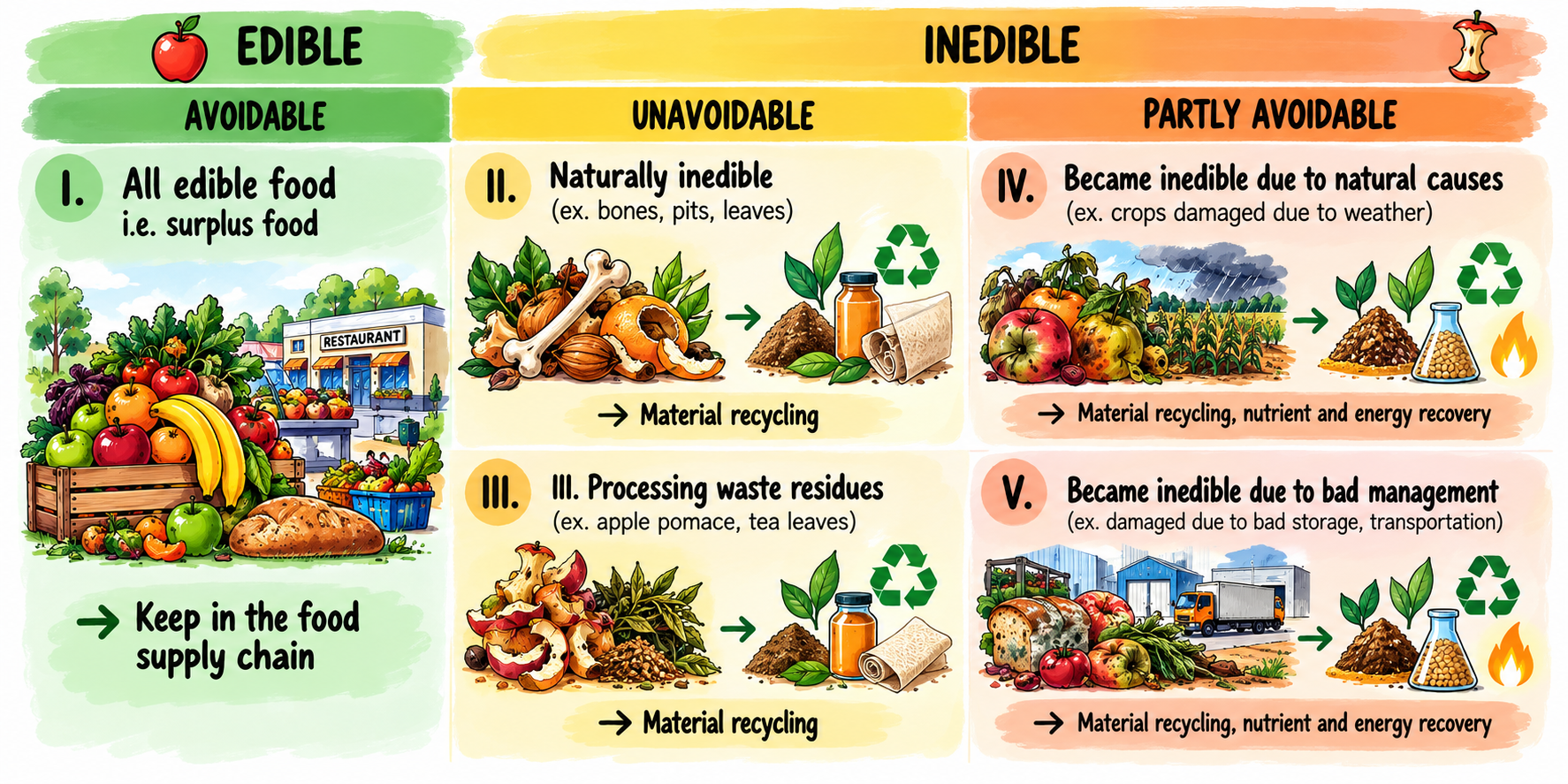
1. First, understand what we're actually wasting
Is it edible? Could its loss have been avoided?
A perfectly edible but unsold apple is fundamentally different from an apple core, a processing residue or fruit that spoiled because of inadequate storage.
Yet these materials are frequently grouped together under the broad label of food waste.
Our research proposed a classification distinguishing edible surplus food from different types of inedible and partly avoidable residues.
Why does this matter? Because you cannot design the right solution if you haven't identified the right problem.
2. Not all circular solutions are created equal
Turning food waste into energy sounds sustainable. So does converting it into fertilizer or new biomaterials.
But what if that material could have fed people? Or been used in a way that retained more of its value?
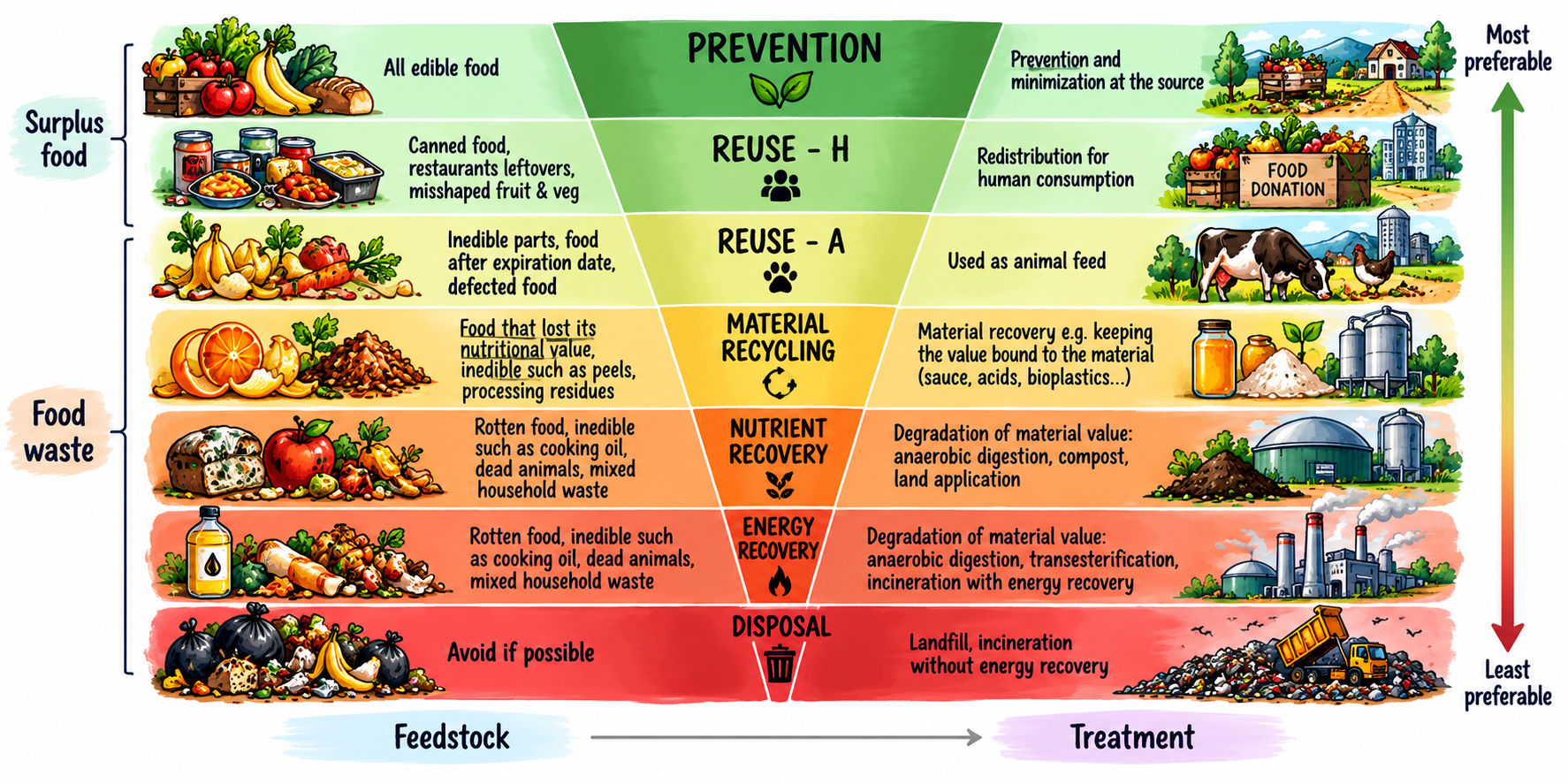
We proposed an updated food surplus and waste hierarchy that prioritises (integrated into European Commission output):
Prevention — avoid generating surplus and waste in the first place.
Reuse — keep edible surplus available for people, followed by suitable materials for animal feed.
Material recycling — retain material value through new products and applications.
Nutrient and energy recovery — recover remaining value where more preferable pathways are unsuitable.
Disposal — avoid wherever possible.
The message is simple: Just because something can be recovered doesn't mean recovery is the best option. The important distinction is to separate material recycling strategies from nutrient recycling (or fertiliser and composting), as these offer very different economic value, but also strategies (for example, biochemical flows of nitrogen and phosphorus).
3. The food system is a network, not a straight line
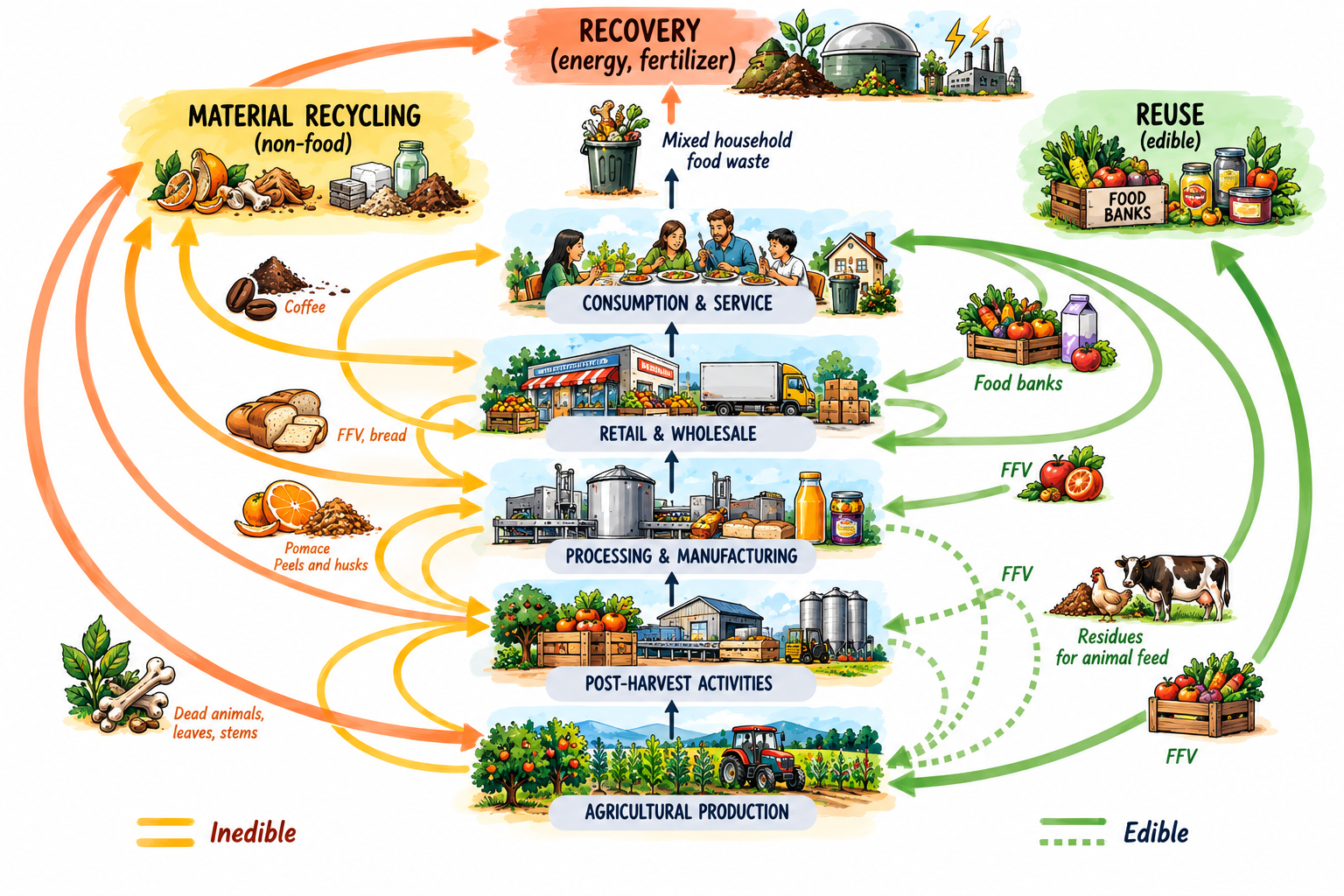
Food moves through farms, processing facilities, retailers, restaurants and households. But resources and residues can move in many directions. Conventional circular economy strategies show flow moving in simple loops and one direction. But food is more heterogeneous and has been part of waste management for humanity since the dawn of agriculture. You may ship a laptop across the world and improve technology to enable technical recycling, but food is highly perishable, and it might not be economical to extract certain materials from mixed food waste just because we can. And when it comes to prevention, social science research shows us that calling something “waste” doesn’t help its prevention.
Instead, the term surplus food is helpful. Those are the parts that can be redistributed. Processing residues can become ingredients or materials. Other streams may return nutrients to agricultural systems.
Our third framework maps these possibilities across the food supply chain, distinguishing pathways for edible and inedible materials.
The bigger question is not simply “What can we make from this waste?” but “How can we organise the whole system to prevent waste, retain value and avoid creating new environmental problems?”
Circularity is a means, not the destination.
One concern raised in our paper remains particularly relevant: if industries become dependent on waste as a raw material, could we inadvertently create incentives to keep producing it? If we produce vegan leather from edible mango waste, we need those resources to BECOME waste in order for the business to survive, and even increase that waste for our business to grow.
A circular economy should not merely become more efficient at processing waste. It should also question why that waste exists, what value is being lost and whether the resulting activities operate within ecological limits.
That is where strong sustainability enters the picture: recognising that economic opportunities and technological innovations must support, rather than compromise, the natural systems on which we depend.
Sometimes the most sustainable innovation is not a new product made from waste.
It's designing a system that doesn't generate that waste in the first place.
Read the research
Teigiserova, D. A., Hamelin, L., & Thomsen, M. (2020). Towards transparent valorization of food surplus, waste and loss: Clarifying definitions, food waste hierarchy, and role in the circular economy. Science of the Total Environment, 706, 136033.
