Urban Greenery: The Future That's Right in Front of Us (But Just Out of Reach)
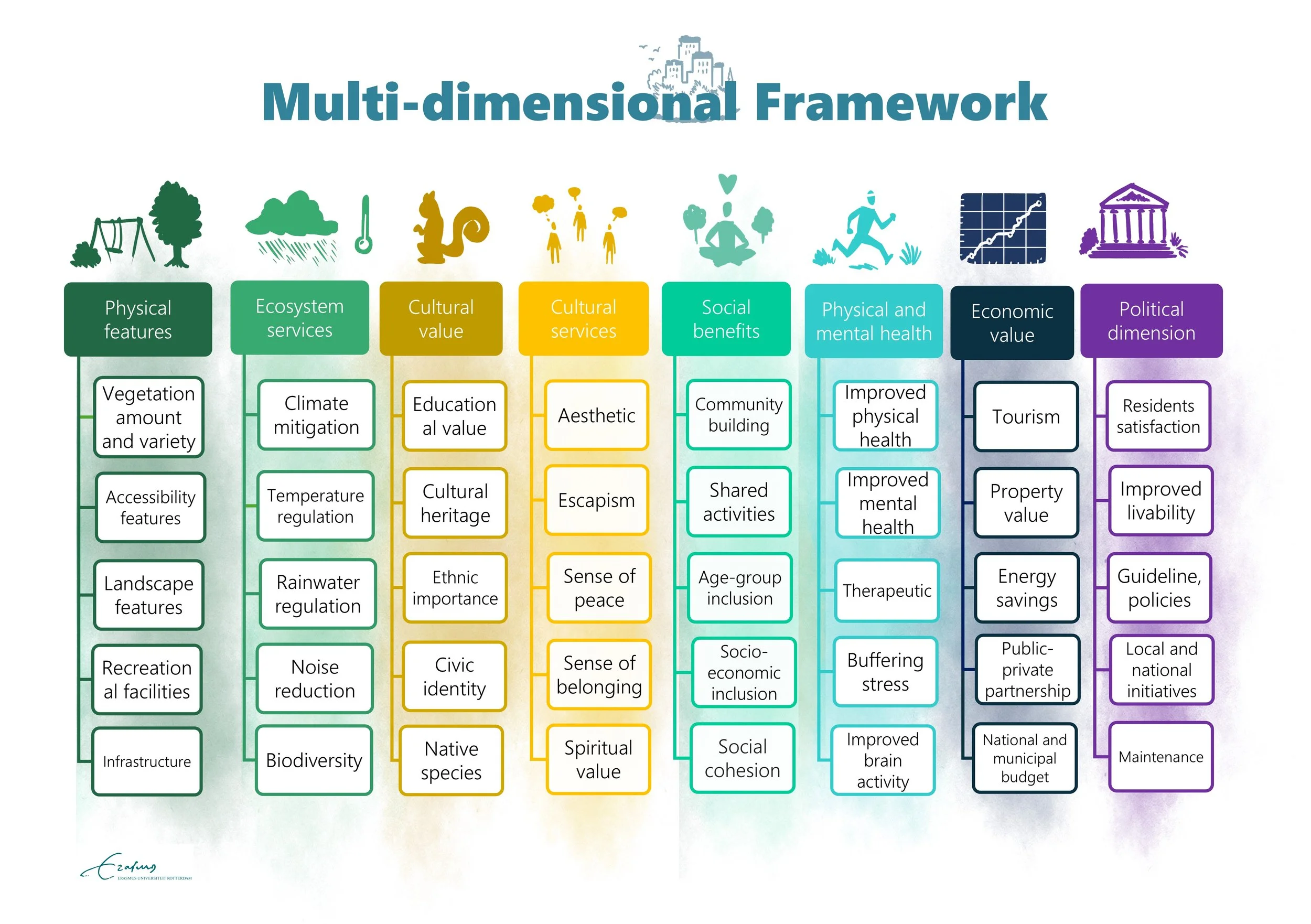
Green cities don't happen by accident – they require collaboration across disciplines and sectors. Architects, urban planners, policymakers, artists, businesses, and community members must work together to integrate greenery into the urban fabric. This can be challenging since we need to navigate multidisciplinary, interdisciplinary, and transdisciplinary collaboration for greener, healthier cities; i.e., we need to engage with many different areas, languages, goals and targets, wants and needs, realistic and prospective solutions. To help stakeholders navigate these challenges, we have designed a booklet and a framework to enhance individual and collaborative solutions. This has been brought about by a plethora of research from different disciplines as well as speaking to city officials. Our framework (Figure 3), in the image above breaks down the true impact of urban greenery across different areas to enable:
🔍 Zoom In: It allows each sector, department, company, and researcher to focus deeply on their specific role—whether it's ecosystem services, public health, economic value, or cultural significance. Experts can use it to strengthen their arguments, justify funding, and refine their impact.
🌍 Zoom Out: At the same time, it helps everyone see how their work connects with others. A scientist researching urban biodiversity can see how their findings support community well-being. A policymaker working on city budgets can recognize the financial benefits of investing in green spaces. A business leader can understand how sustainability efforts align with economic growth.
🤝 A Tool for Collaboration: This framework doesn't just categorize benefits—it creates common ground. It encourages professionals from different backgrounds to speak the same language, making it easier to align goals, share resources, and collaborate across disciplines, sectors, and departments.
Making Green Cities a Reality
If we want greener, healthier, more resilient cities, we don't need to start from scratch. We already have the knowledge, the innovations, and the will to make it happen. What we need is to connect the dots. So, whether you're a policymaker, a designer, a scientist, a business leader, or a community activist—this framework is for you. Use it to strengthen your case, broaden your perspective, and build partnerships that turn urban greenery from vision into reality.
Let's move beyond isolated efforts and build networks of change—I invite you to explore the booklet, share ideas, and collaborate on transforming our urban landscapes. A greener city is not just a vision; it's a necessity. The trees, gardens, and green roofs of tomorrow begin with the decisions we make today. Let's plant the seeds together. Because a city without greenery is a city without a future—the air you breathe, the heat you feel, and the stress you carry are all shaped by it, whether you care about it or not.